
Downriver driveways, patios and walks
Concrete Contractors in Taylor, MI
Replacing the tired concrete around Taylor's postwar homes with slabs built for clay ground, salt and Michigan winters.
- Free measuring visit at the property
- Itemized written quote for every job
- Permit status checked with Taylor's Building Department before scheduling
Concrete Work for Taylor's Older Homes
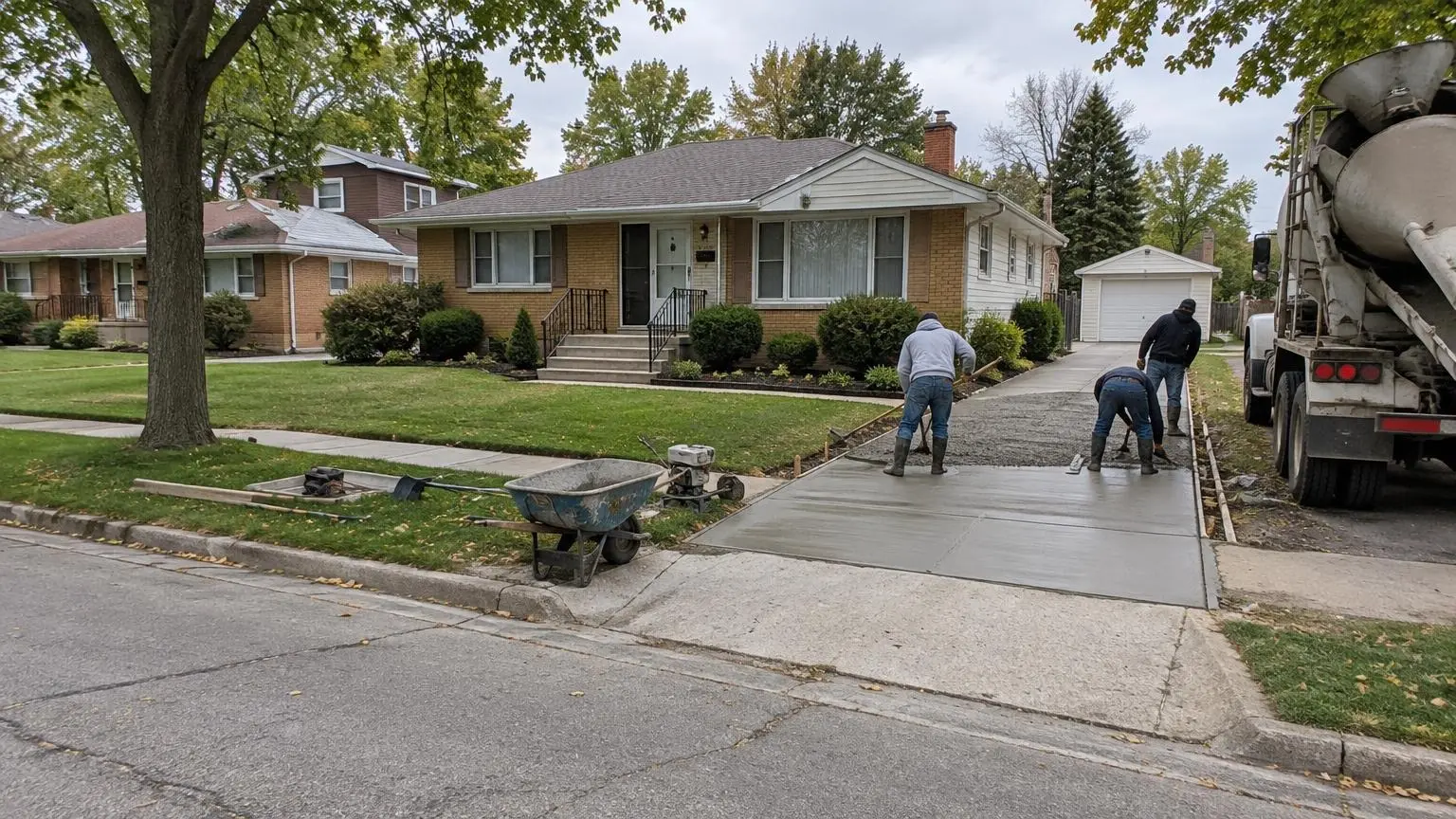
Taylor Concrete Contractors replaces and repairs driveways, patios, stamped surfaces, walks, steps and garage floors for homeowners in Taylor, Michigan. Taylor is the most populous community Downriver, with 63,409 residents at the 2020 census spread across 23.6 square miles of Wayne County, crossed by I-94 in the north and I-75 in the southeast corner. Wikipedia's article on Downriver notes the city grew mainly from the 1950s through the 1970s, when postwar tract homes and subdivisions filled in former farmland. That history shapes almost every job concrete contractors in Taylor take on today: the original concrete is old, and much of it was never built for the weight and salt it sees now.
A city built in three decades
Point2Homes, summarizing Census survey data, puts the median year built for Taylor housing at 1963. The 1950s alone account for 31.3 percent of homes, the 1960s for 21.4 percent and the 1970s for 18.3 percent. Only about 17 percent were built in 1980 or later. Nearly three in four housing units (72.8 percent) are single-family detached houses, and about two-thirds are owner-occupied.
For concrete, that means:
- Driveways, service walks and stoops on many streets are 45 to 75 years old
- Some were poured before air-entrained concrete was routine on residential work, so they flake badly after salt
- Narrow single-lane drives laid out for one 1950s sedan now carry two or three modern vehicles
- Garage floors and the strip where the drive meets the garage have often dropped as the ground below washed out
Clay ground and slow water
Taylor is flat, low country. The South Branch of the Ecorse River runs through the city along with the Sexton-Kilfoil, Bondie and Brighton drains, and Wikipedia's Ecorse River article describes a very low-gradient river whose clay soils and dense development limit how much rain the ground can absorb. Water that cannot soak in sits under slabs, freezes, and lifts them; in spring the softened clay lets them settle. The fix is not thicker concrete alone. It is digging out soft material, building a compacted stone base that lets water drain, and pitching every slab so runoff leaves the house and garage. Taylor's Department of Public Works keeps FEMA flood insurance rate maps for the city, and residents can ask the department about the flood status of a property.
Built for a Detroit-area winter
Wikipedia lists Taylor's January average at a high of 32 degrees and a low of 18. At the Detroit Metro Airport weather station a few miles west in Romulus, the 1991 to 2020 normals show 45 inches of snow a year. That adds up to months of freezing and thawing, plow blades and rock salt. On every outdoor slab we pour, we use:
- Air-entrained concrete, whose tiny bubbles give freezing water room to expand
- A compacted stone base under the slab instead of bare clay
- Thickness matched to the load, from about 4 inches for walks and patios to 5 or 6 where trucks or trailers park
- Joints on a planned layout, so cracks form in straight lines where they belong
- A proper cure, with no salt on new concrete its first winter
Permits in Taylor
The City of Taylor's Building Department, at City Hall on Goddard Road (734-287-6550), lists concrete or asphalt work, patios, driveways and approaches, public sidewalks and service walks, garages and sheds among the jobs that require a permit, and strongly recommends calling before work starts. A copy of the construction contract is required with any permit application. The city's zoning review fee is waived for removal and replacement of existing concrete, though the permit itself still applies. We confirm what your job needs and build it into the schedule, so you are not the one standing in line at City Hall.
Six kinds of work
- Driveways: tear-out and replacement, widening a single lane to a double, new approaches and parking pads.
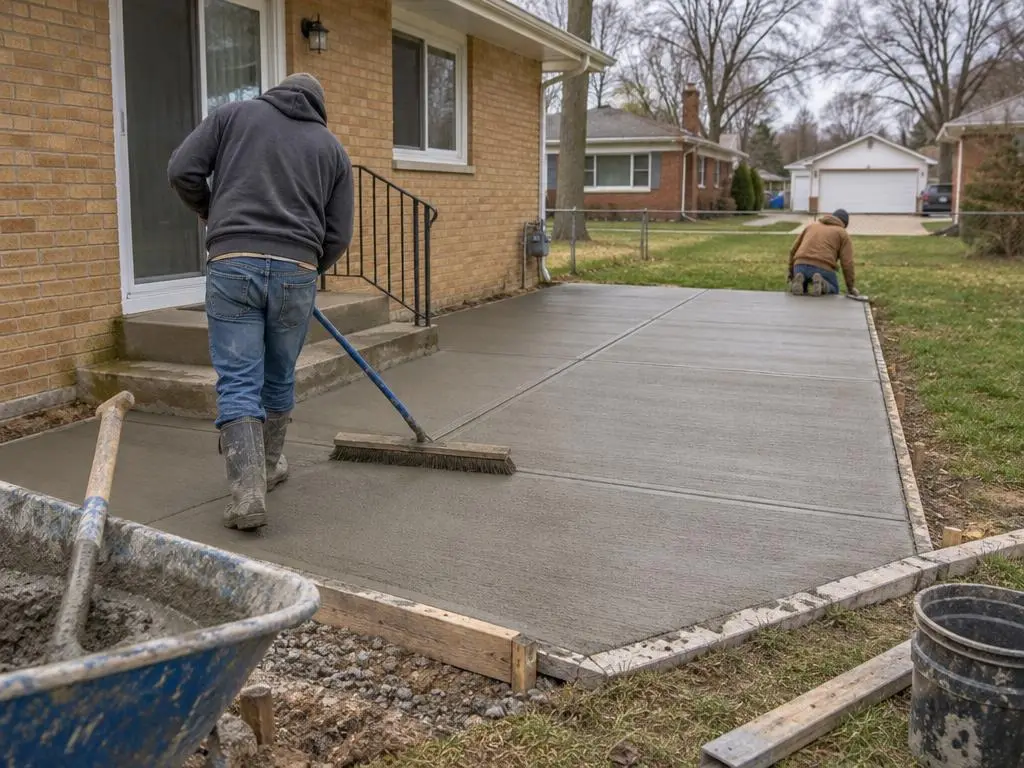
- Patios: broom, colored or exposed-aggregate slabs, with paths to the drive or garage.
- Stamped concrete: slate, stone and brick patterns for patios, entries and driveway borders.
- Sidewalks, steps and porches: service walks, side paths, front stoops and poured steps.
- Garage floors and slabs: replacement floors for attached and detached garages, plus shed and equipment pads.
- Repair and leveling: slab lifting, crack sealing, resurfacing and replacement of single panels.
What a job looks like
Visit. We walk the site with you, measure, and look at drainage, the age of the concrete and what is under it.
Quote. An itemized written price. When a repair is a real option, it sits next to the replacement price.
Prep. Old concrete broken out and hauled, soft soil removed, stone base compacted, forms set to grade.
Pour. Reinforcement where the slab needs it, then placing, finishing and jointing.
Handoff. Written dates for foot traffic, cars and the first sealer coat. HomeGuide's driveway guide says to wait at least 7 days before driving on new concrete and about 30 days for heavy vehicles.
When to call
Most exterior concrete in southeast Michigan goes in between the spring thaw and the first hard freeze. Concrete that freezes before it gains strength can be ruined, so late-fall pours need a forecast of nights above freezing and sometimes insulated blankets. Calling in late winter or early spring gets you measured and on the calendar before the busy months. If you call in October or November, we will tell you straight whether to pour now or wait. Reach us at (313) 351-8654.
Our Concrete Services
Driveways, patios, stamped work, walks and steps, garage floors and repairs, each built for clay soil and freeze-thaw winters.
Concrete Driveways
Tear-out and replacement driveways on a drained stone base, widened where the household has outgrown a single lane.
Learn more →Concrete Patios
Backyard patios in broom, colored or exposed-aggregate finishes, sloped away from the house and sized for how you use the yard.
Learn more →Stamped Concrete
Concrete pressed and colored to look like slate, stone or brick, then sealed to stand up to salt and freeze-thaw.
Learn more →Sidewalks, Steps & Porches
Service walks, side paths, front stoops and poured steps rebuilt level, with even risers and a solid footing.
Learn more →Garage Floors & Slabs
Replacement floors for attached and detached garages, plus shed and equipment pads, reinforced and pitched to drain.
Learn more →Concrete Repair & Leveling
Lifting sunken slabs, sealing cracks, resurfacing flaked concrete and replacing single panels that cannot be saved.
Learn more →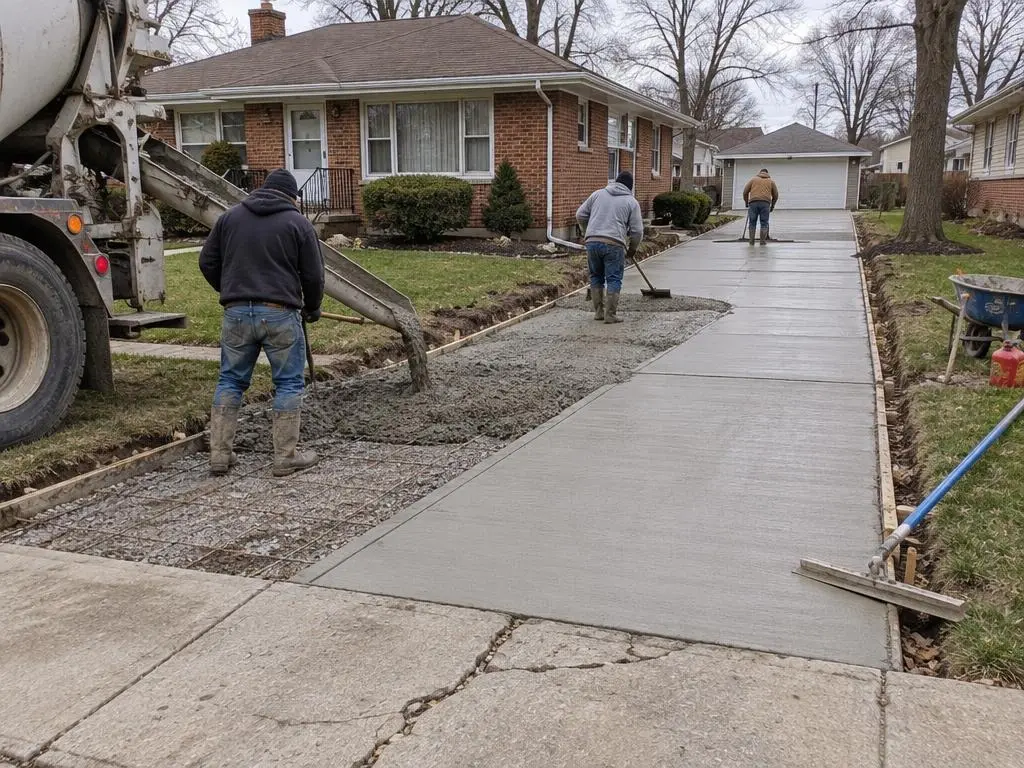
Common Questions
What should I look for in residential concrete contractors in Taylor?
Get two or three written bids and compare what they include, not just the total. Each should state slab thickness, base depth, air-entrained concrete, reinforcement, joint layout and who pulls the permit. Ask the bidder why your current slab failed. Someone who can point to drainage, clay or a thin base is more likely to build the new one so it lasts.
How do I compare the best concrete contractors in Taylor when reviews look alike?
Ask each one the same questions: how deep the stone base will be, whether the mix is air-entrained, where the joints go and when you can drive on it. Ask whether removal and hauling are included and whether the permit is in the price. Vague answers on the base are a warning sign, because that is where most Taylor slabs fail.
Do I need a permit for concrete work in Taylor?
Usually, yes. The City of Taylor's permits page lists concrete or asphalt work, patios, driveways and approaches, and public sidewalks and service walks among the jobs that need a permit, and recommends calling the Building Department at 734-287-6550 before starting. We confirm the permit for your job and include it in the schedule.
What does a new driveway cost?
HomeGuide's national cost guide lists standard concrete driveways at $6 to $10 a square foot installed and $2,400 to $6,000 for a 20-by-20-foot two-car drive. Removing an old driveway adds $2 to $6 a square foot. Local prices vary, so the written quote after we measure is the real number.
Why do so many older Taylor driveways sink near the garage?
Water is usually the cause. Runoff from the roof and drive collects at the low point by the garage, soaks the clay under the slab, and washes out or softens the base. The slab then drops and holds a puddle, which makes it worse. A new base, a proper pitch and downspouts pointed away from the drive stop the cycle.
Why does my concrete flake every spring?
That is scaling. Water in the top layer freezes and expands, and rock salt increases the number of freeze-thaw cycles and keeps the surface wet. Older slabs poured without entrained air are the most vulnerable. Light scaling on a sound slab can be resurfaced; deep scaling over most of the surface usually means replacement.
Can concrete be poured in a Michigan fall?
Yes, as long as the concrete does not freeze before it gains strength. We need nights above freezing in the forecast and may cover the slab with insulated blankets. Once the ground freezes, waiting for spring is usually the better choice.
How long before I can use a new driveway?
Light foot traffic is usually fine after a day or two. HomeGuide recommends at least 7 days before driving on a new driveway and about 30 days before heavy vehicles. We give you dates in writing based on your slab and the weather that week.
Why Homeowners Call Taylor Concrete Contractors
Base first
Soft clay dug out and replaced with compacted stone, so the new slab does not settle like the old one.
Itemized pricing
Removal, base, thickness, steel, finish and sealing priced on separate lines so bids compare fairly.
Repair when it works
Leveling, resurfacing or single-panel replacement quoted when the slab is worth saving.
Permits sorted
We check Taylor's permit list for your job and handle the paperwork before pour day.
Where We Work
Most of our work is in Taylor itself, from the blocks off Telegraph Road to the streets along Eureka, Goddard and Van Born roads. We also cover the Downriver and western Wayne County cities around it: Dearborn Heights and Westland to the north, Allen Park and Southgate to the east, Lincoln Park and Wyandotte toward the Detroit River, Romulus and Inkster to the west, and Dearborn and Brownstown Township a short drive beyond. Housing in these towns is similar in age to Taylor's, but each city runs its own building department and sets its own permit rules for driveways, approaches and public walks. Our town pages note what we found for each one, and we confirm the rules for your address before any work is scheduled.
- Concrete Contractors in Taylor, MI
- Concrete Contractors in Dearborn, MI
- Concrete Contractors in Dearborn Heights, MI
- Concrete Contractors in Westland, MI
- Concrete Contractors in Southgate, MI
- Concrete Contractors in Allen Park, MI
- Concrete Contractors in Lincoln Park, MI
- Concrete Contractors in Wyandotte, MI
- Concrete Contractors in Romulus, MI
- Concrete Contractors in Riverview, MI
- Concrete Contractors in Trenton, MI
- Concrete Contractors in Woodhaven, MI
- Concrete Contractors in Brownstown, MI
- Concrete Contractors in Wayne, MI
- Concrete Contractors in Inkster, MI
- Concrete Contractors in Garden City, MI
- Concrete Contractors in Melvindale, MI
- Concrete Contractors in Flat Rock, MI
- Concrete Contractors in Canton, MI
- Concrete Contractors in Van Buren Township, MI
- Concrete Contractors in Belleville, MI
- Concrete Contractors in Grosse Ile, MI
- Concrete Contractors in Ecorse, MI
- Concrete Contractors in River Rouge, MI
- Concrete Contractors in Livonia, MI
- Concrete Contractors in Huron Township, MI
Get a Free Concrete Estimate in Taylor
We measure on site and give you a written price, in Taylor and the nearby Downriver cities.